
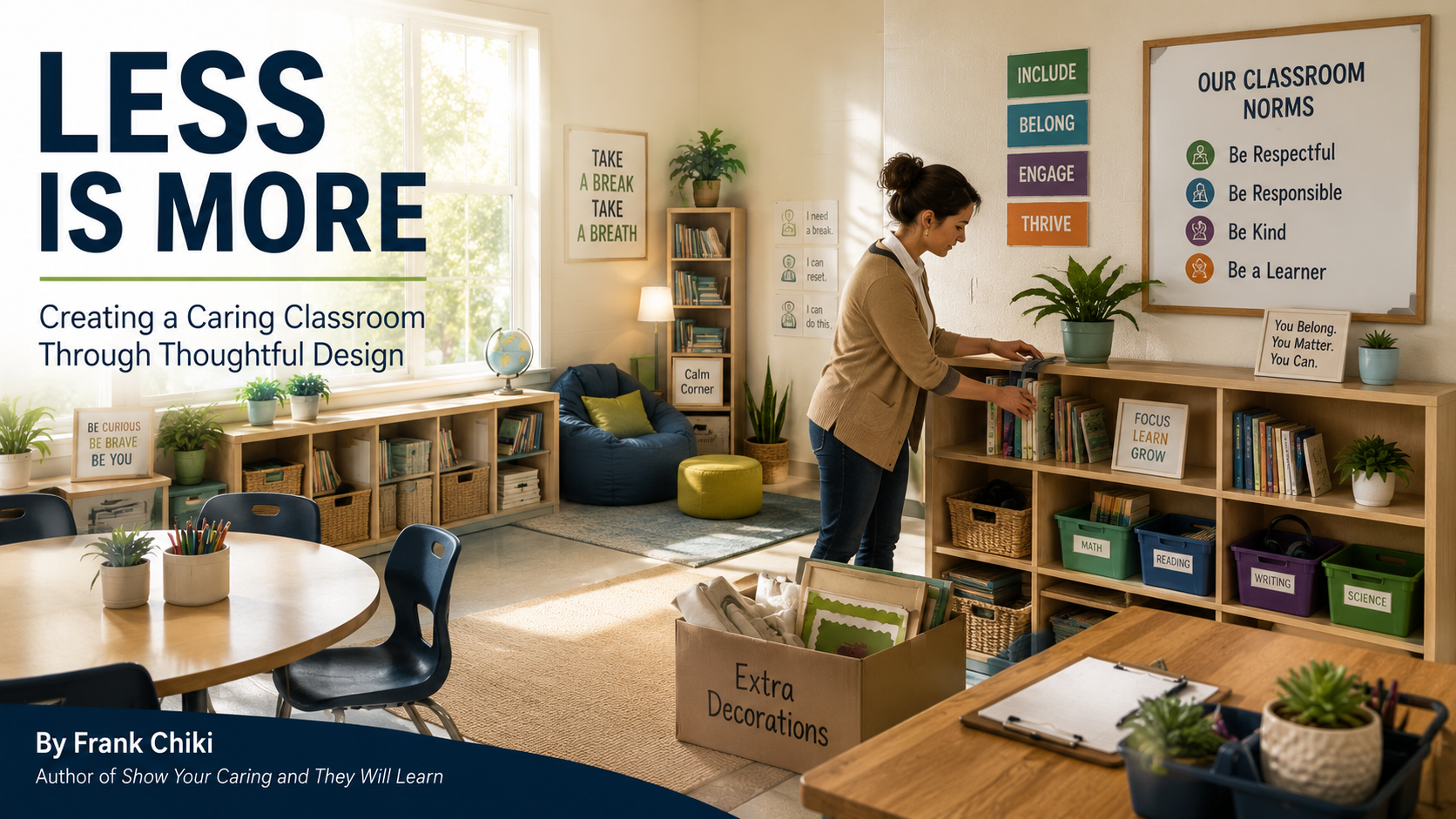
There is something incredibly satisfying about preparing a classroom for a new school year.
The floors have been waxed. Empty bulletin boards are waiting to tell new stories. Boxes of supplies sit stacked in the corner, and fresh ideas begin taking shape as you decide where desks, bookshelves, and learning centers should go.
For many educators, this is one of the most exciting times of the year. Pinterest boards come alive. Social media fills with beautifully decorated classrooms. We find ourselves asking, “How can I make my room feel welcoming?”
It’s a wonderful question.
But perhaps there’s another question we should ask first.
“How can I make my classroom help every student learn?”
The answer isn’t always adding something new.
Sometimes it’s removing something that’s already there.
Over the years, classroom design has evolved. We’ve learned more about how physical environments influence attention, learning, and emotional well-being. While colorful bulletin boards and inspiring decorations certainly have their place, research also reminds us that overly busy visual environments can compete for students’ attention, increase cognitive load, and make it more difficult for some learners to focus—particularly our youngest students and those who are easily distracted or have sensory sensitivities.
That doesn’t mean classrooms should feel empty.
It means every element should have intention.
One of the greatest gifts we can give students is a classroom that quietly communicates, “Everything here is designed to help you succeed.”
As you begin setting up your classroom this year, here are five questions worth asking yourself.
1. Does Everything Have a Purpose?
Walk around your room slowly.
Look at every poster.
Every bulletin board.
Every decorative item.
Every piece of furniture.
Ask yourself a simple question:
Does this serve a specific and identifiable purpose for student learning, belonging, or well-being?
If the answer is yes, it probably deserves its place.
If not, perhaps it is simply taking up visual space that could be better used elsewhere.
A caring classroom isn’t about filling every blank wall.
It’s about filling the room with intention.
2. What Do Students See?
When we arrange our classrooms, we often do so from the perspective of the teacher.
Instead, sit in a student’s chair.
Better yet, sit in several.
Can students clearly see instructional displays?
Can they see one another during collaborative work?
Can they easily locate important resources?
Are sightlines blocked by tall furniture, oversized decorations, or unnecessary storage?
Simple adjustments often make classrooms feel more open, accessible, and welcoming.
Students shouldn’t have to work harder just to see what they’re trying to learn.
3. Is My Classroom Calm or Busy?
Many of us love colorful classrooms.
Children do, too.
But there is a difference between colorful and cluttered.
Educational research has shown that environments filled with excessive visual stimuli can make it more difficult for students to maintain attention and process new information. This can be especially challenging for students with ADHD, autism, anxiety, or other sensory processing differences.
Consider creating intentional areas of visual rest.
Leave some wall space open.
Limit competing displays.
Rotate instructional materials rather than displaying everything all year.
When everything demands attention, nothing truly receives it.
A calm classroom helps students direct their energy toward learning rather than filtering distractions.
4. Does My Classroom Support Different Ways of Learning?
Every student enters our classroom differently.
Some learners thrive with visual reminders.
Others benefit from hands-on materials.
Some need movement.
Some need quiet.
Some appreciate flexible seating.
Others concentrate best at a traditional desk.
A caring classroom doesn’t try to make every student learn the same way.
Instead, it creates options that help students experience success.
As you organize your room, ask yourself whether students can independently access materials, move comfortably through the space, and find places that support both collaboration and focused work.
Accessibility is caring in action.
5. What Message Does My Classroom Send Before I Speak?
Long before we introduce ourselves, our classroom has already begun communicating.
Does it feel warm?
Organized?
Predictable?
Inclusive?
Does it reflect the diverse students and families who will soon walk through the door?
Will students see books that reflect different cultures and experiences?
Will multilingual learners feel welcomed?
Will students with disabilities recognize that they belong here?
Will every child believe this room was prepared with them in mind?
Perhaps the greatest purpose of classroom design isn’t decoration at all.
It’s creating an environment where students immediately think:
“I belong here.”
As educators, we often believe caring is demonstrated through our relationships—and it absolutely is.
But caring also shows up in our planning.
It appears in thoughtfully labeled bins that help students become independent.
It is found in uncluttered walkways that make classrooms accessible to everyone.
It lives in clearly organized learning spaces that reduce anxiety and help students know what to expect.
It is reflected in calm environments that allow every learner—not just the easiest learners—to focus on what matters most.
None of us will create the perfect classroom.
Nor should we try.
Our students don’t need perfection.
They need intentionality.
As I wrote in Show Your Caring and They Will Learn, caring isn’t something we add after we’ve planned instruction. Caring shapes every decision we make—including the environments we create. Sometimes the most caring thing we can do isn’t to add another decoration or another display.
Sometimes it’s simply making room.
Making room for focus.
Making room for belonging.
Making room for every child to succeed.
As you prepare your classroom this year, I invite you to look at your room one more time before students arrive.
Not as a teacher.
Not as a decorator.
But as a child walking through the door for the very first time.
Will your classroom help students feel calm before they are challenged? Will it help them focus before they are assessed? And what one thing could you remove today that would make more room for learning tomorrow?
About the Author
Frank Chiki is an educator with more than 20 years of experience serving students, teachers, and school leaders in roles ranging from Educational Assistant to State Director of Title Grants and Support. Throughout his career, he has championed the belief that meaningful relationships are the cornerstone of student success. Frank is the author of Show Your Caring and They Will Learn, which encourages educators to intentionally build classrooms where every student feels seen, valued, and inspired to learn. Through his writing, speaking, and consulting, he helps schools strengthen both instructional practice and the culture of caring that allows students and educators to flourish.
Leave a Reply