
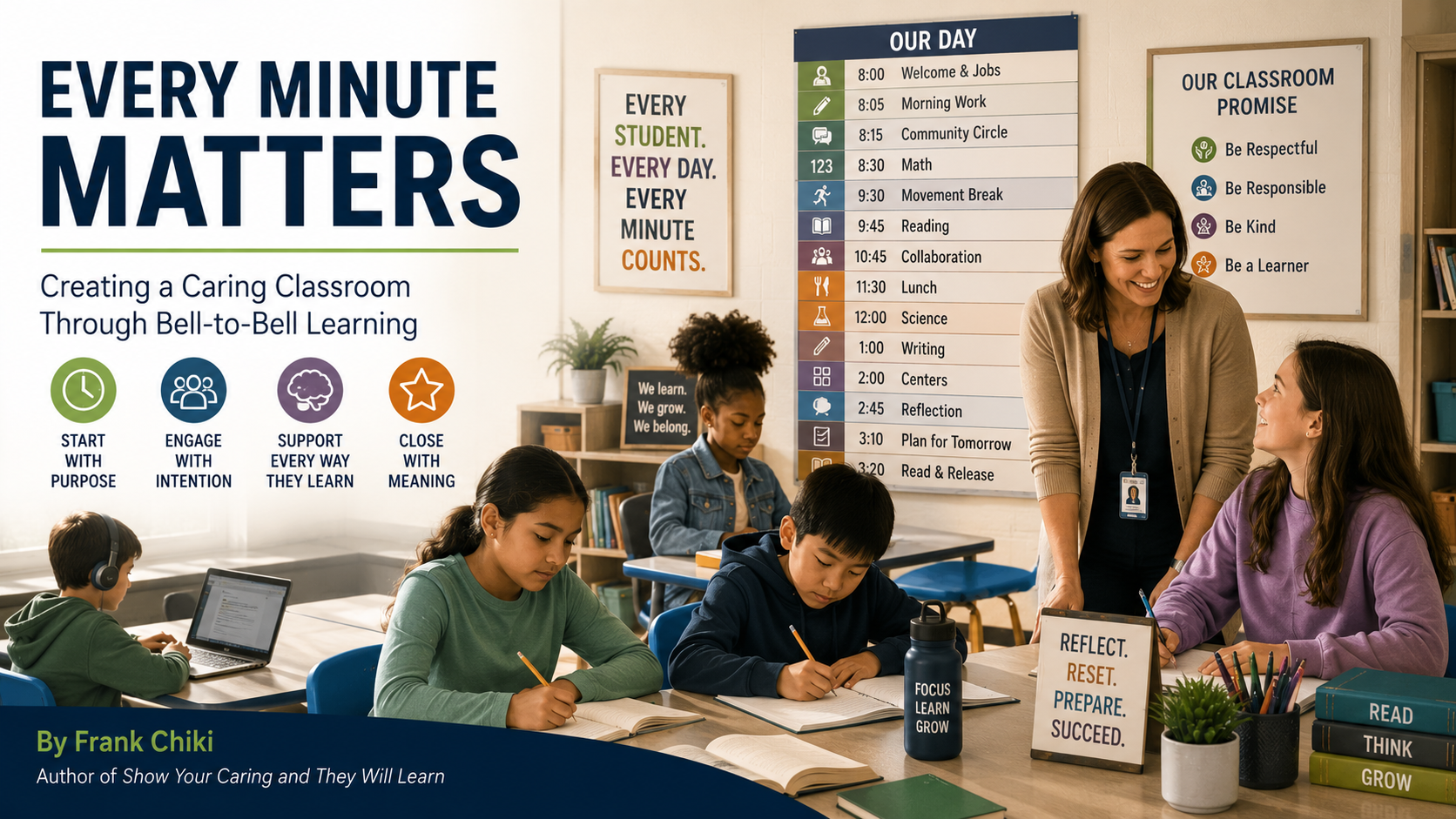
There is something special about the first few moments of a school day.
Students trickle through the classroom door carrying backpacks, lunchboxes, and stories from the night before. Some arrive eager to begin. Others need a few quiet moments to settle in. A smile from a teacher, a familiar routine, and a welcoming classroom can set the tone for everything that follows.
Those first few minutes matter.
So do the last few.
And every minute in between.
When educators hear the phrase bell-to-bell learning, it sometimes brings to mind students working nonstop from the opening bell until dismissal. It can sound exhausting—for both students and teachers.
But I believe bell-to-bell learning means something much more meaningful.
It isn’t about keeping students busy.
It’s about making every minute matter.
In caring classrooms, every part of the day has purpose. Sometimes students are solving challenging problems. Sometimes they’re collaborating with classmates. Sometimes they’re reading quietly, reflecting in a journal, moving during a brain break, or helping care for the classroom community through daily responsibilities.
Learning looks different throughout the day.
Purpose never changes.
As you prepare for another school year, here are five ways to create meaningful learning from the first bell to the last.
1. Begin the Day with Purpose
The first minutes after students arrive often determine how smoothly the rest of the day unfolds.
Rather than waiting for announcements or attendance, invite students into meaningful work immediately.
For younger learners, that might include classroom jobs, morning tubs, calendar activities, handwriting practice, or a simple math challenge.
Older students might respond to a journal prompt, retrieval practice, current events discussion, vocabulary review, or a problem that sparks curiosity before instruction begins.
These activities do more than occupy students.
They provide consistency.
They reduce anxiety.
They establish expectations.
Most importantly, they quietly communicate:
“Learning begins because you are here.”
2. Design Learning with Intention
Every lesson should answer an important question:
Why are students doing this?
Purposeful learning isn’t about adding more activities.
It’s about choosing the right activities.
Research consistently reminds us that students learn best when they actively engage with new ideas rather than simply receiving information. Whether students are participating in discussions, collaborating with peers, practicing new skills, or reflecting on their thinking, intentional experiences deepen understanding and increase engagement.
Busy work fills time.
Purposeful work builds learning.
Our students deserve the latter.
3. Remember That Learning Doesn’t Always Look the Same
One of the greatest misconceptions about bell-to-bell learning is that students should remain seated and working independently all day long.
Nothing could be further from the truth.
Students need movement.
They need conversation.
They need opportunities to create, question, investigate, and reflect.
Brain breaks help students reset.
Hands-on activities make abstract ideas concrete.
Partner discussions strengthen understanding.
Classroom jobs build responsibility and belonging.
Learning is happening in all of those moments because each has a clear purpose.
In caring classrooms, intentional movement and meaningful transitions are just as valuable as direct instruction.
4. Protect the Last Minutes of the Day
If we’re honest, the last ten minutes of the day can sometimes become “waiting time.”
Students pack early.
Teachers finish paperwork.
Everyone watches the clock.
But those final minutes offer remarkable opportunities.
Independent reading.
Reflection journals.
Goal setting.
Student conferences.
Exit tickets.
Sharing successes.
Previewing tomorrow’s learning.
Celebrating acts of kindness witnessed throughout the day.
These closing routines help students organize their thinking while ending the day with a sense of accomplishment rather than simply anticipation for dismissal.
Just because the clock is approaching the final bell doesn’t mean learning has ended.
5. Let Every Minute Communicate Caring
Purposeful classrooms send powerful messages.
When students have meaningful work waiting as they arrive, they know their time matters.
When transitions are organized, they feel safe.
When lessons are thoughtfully planned, they understand their teacher values their learning.
When the final minutes of the day include reflection rather than simply waiting, students leave believing their day had purpose from beginning to end.
Bell-to-bell learning is ultimately about respect.
Respect for students’ time.
Respect for their potential.
Respect for every opportunity we have to help them grow.
As educators, we know learning doesn’t occur only during a lesson.
It happens during conversations.
It happens while solving problems together.
It happens when students help classmates.
It happens during quiet moments of reflection.
It even happens while organizing materials for tomorrow.
Every minute holds the possibility of growth.
As I wrote in Show Your Caring and They Will Learn, caring is demonstrated through intentional choices. One of the most caring choices we make is ensuring that every student feels their time at school has value. When every part of the day is thoughtfully planned—not rushed, not filled for the sake of filling time, but designed with purpose—we communicate something important:
“Your learning matters.”
“Your time matters.”
“You matter.”
None of us will have a perfect day.
Lessons will occasionally run long.
Technology will fail.
Unexpected interruptions will happen.
That’s the reality of teaching.
But even on imperfect days, we can remain intentional.
Because bell-to-bell learning isn’t about perfection.
It’s about purpose.
As you prepare your lessons this year, I encourage you to think about the first five minutes of your day—and the last five minutes as well.
Not simply as bookends to instruction, but as opportunities to build relationships, strengthen learning, and remind students that every moment they spend in your classroom is meaningful.
What message do your first five minutes send to students each morning? And when the final bell rings, will your students leave feeling they simply finished another school day—or that every minute truly mattered?
Leave a Reply